Judy Middleton 2003 (revised 2022)
 |
copyright © J.Middleton
This charming old postcard view of St Barnabas
dates from around 1906, and it is amusing to note the rampant ivy |
Hove’s Rapid Growth
The reasons for
the establishment of St Barnabas was the rapid growth in Hove’s
population. The situation was charmingly described in
the following extracts from A
Cameo of History published
in 1901:
‘The sudden and rapid growth of Hove, and the
consequent great increase of population, which began more than 25
years ago, was a heavy strain on the Ecclesiastical arrangements of
the Parish of Hove. Large houses were springing up on every side, and
land which a few old inhabitants can still remember as fields was
quickly covered. Naturally, the great demand for bricklayers,
builders and every kind of labourer brought a very large
working-class population to the neighbourhood. Work was plentiful,
wages good, and the quiet little town of Hove became a very large and
prosperous community.’
 |
copyright
© Royal Pavilion & Museums
Revd Thomas Peacey
Vicar of All Saints, Hove, 1874-1904
the founder of St Barnabas |
The Revd Thomas Peacey, who became vicar of Hove
in 1874, was well aware of what was happening in the west part of his
parish. It was he who instigated the building of St Barnabas, which
became in fact the daughter church of All Saints with financial
assistance until the parting of the ways in 1915.
It is pleasant to record that Hove Christians made
vigorous and successful efforts to provide spiritual welfare for
this rather overpowering addition to the flock. Many ladies came
forward to help, and soon the streets that were so quickly appearing
on the east side of Sackville Road were well provided with District
Visitors – those Visitors ‘who had sufficient energy to penetrate
into such an out-of-the-way place as Shirley Street being considered
especially worthy of praise.’
Miss Baines and Miss Bullen established a Sunday
School in Conway Street. This was quaintly situated in a corn-loft
with the only means of access being by a narrow ladder, but there is
no record of either child or helper falling off. The building was
known as the Saw Mills, and was near a pub. Partitions were erected
in the loft in order to separate the classes.
The announcement of a Parochial Tea caused quite a
stir in the neighbourhood. This was followed by a concert in the
Conway Street Mission Hall. Miss Baines managed to rope in the help
of her brother on this occasion. At the time he was a young Oxford
graduate who later became Bishop of Natal.
Planning for a New Church
On 14 March 1881 the first meeting of the Building
Committee took place at Hove Town Hall. It was noted that ‘This
meeting of the parishioners of Hove recognises the necessity of a new
church for the large and increasing population of the north-west of
the parish composed almost entirely of labouring people.’
The Meeting approved of the site offered by Messrs
Beves, situated on the west side of Sackville Road / Hove Drove. At
the time the land was being used for allotments – before that it
had been a cornfield, and it was also a site where travelling gypsies
were accustomed to set up camp.
 |
copyright © St Barnabas Church, Hove
Revd Thomas Peacey
in later years
|
On 2 April 1881 a public meeting was held at Hove
Skating Rink in Holland Road at which the Bishop of Chichester was in
attendance. It was stated that it was now eighteen years since the
Holy Trinity Church had been built in
Blatchington Road. It was also recorded that near
to the site of the proposed new church, some 600 houses were to be
built in the following three or four years. These houses were
intended for mechanics, artisans, and other labouring people, many of
whom were relatively poor, and only earned sixteen or seventeen
shillings a week.
The first priority was to raise £1,500 to
purchase the site, and then hope to build a church to accommodate 900
people at a cost of £5,000. (As so often happens, these figures were
unrealistic, and the final cost of land and buildings came to
£8,710).
Revd Thomas Peacey mentioned the difficulty of
raising money locally. This was because a large proportion of the
population came to Hove for pleasure, or after they had retired from
service in the colonies, and they had no desire to take up other
burdens.
James Warnes Howlett said it was extraordinary
that in a town of 20,000 inhabitants, so few people had their roots
here, and it was a constantly shifting population. Although he had
lived at Hove for the previous 25 years, he knew no more people
socially than he did at the outset.
At another
meeting held on 16 February 1882, the architect John Loughborough
Pearson was present with the plans he had drawn up; the fees came to
£325-19-8d. J.
L. Pearson (1817-1897) was a very popular Victorian architect with Truro Cathedral, St John's Cathedral (Brisbane, Australia) and a
large number of churches to his credit. His favoured style was known
as Gothic Revival, and at Hove, as well as St Barnabas Church, he was
also responsible for All Saints in The Drive.
On 5 April 1882 John Shillitoe’s tender to build
the church for £5,400 was accepted. Shillitoe was based at 30 Palace
Square, Upper Norwood, London.
Laying the Foundation Stone
 |
copyright © St Barnabas Church, Hove.
Laying of the foundation stone of St Barnabas 27 May 1882 |
On
27 May 1882 the Bishop of Chichester, Rt. Revd Dr Durnford, by then
in his eighties, laid the foundation stone for the new church of St
Barnabas in front of a crowd numbering between four and five hundred
people, and included many of the Hove Commissioners, and some 200
children and their teachers from the National Church School. The
procession started from the Parochial Institute, Livingstone Road,
headed by the choir of the parish church, and followed by the Bishop,
the vicars of Brighton and Hove, and around twenty other local
clergy. They sang the hymn Onward
Christian Soldiers, which
was also sung when the church was consecrated.
The foundation stone was a massive block and it
was carefully lowered by means of a pulley. Beneath the stone there
was a cavity into which a sealed bottle had been placed. The contents
of the bottle were as follows:
A
copy of that day’s London
Times
A
copy of the Sussex
Daily News
The Parish Report, containing the vicar’s
address, and a list of subscribers
A Pamphlet recording the first Public Meeting for
a new church on 2 April 1881
The Bishop then gave a short address in which he
stated that the people of this area had ‘homes for their material
wants, but they had no home for their spiritual wants’.
St Barnabas Church consecrated
In a remarkably short time after the foundation
stone was laid, the church was ready for service only thirteen
months later.
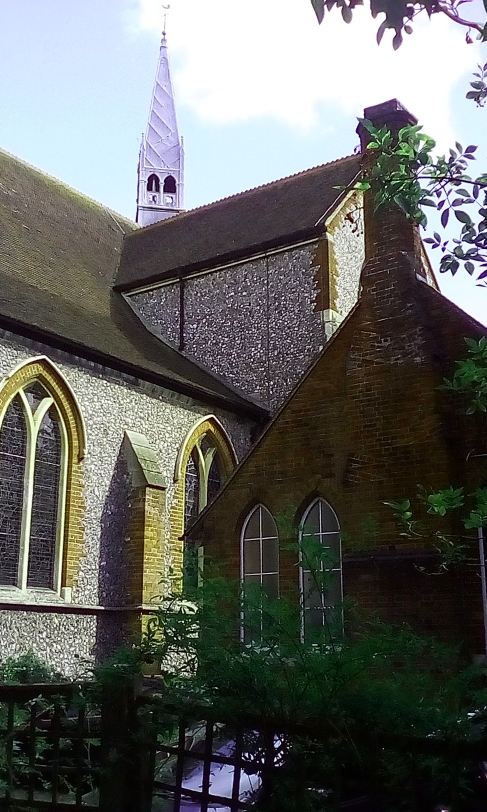
The building was of brick faced by knapped flints,
and red brick and Bath stone dressings on the exterior. It was
cruciform with a seven-sided apse. The original design included a
tower at the south-west corner but although the base was built, the
tower was never completed. J. L. Pearson described St Barnabas as
‘one of my cheap editions’. But perhaps Pearson was being unduly
modest and he must have liked his work because he later used almost
the same design for St Matthew’s Church, St Leonard’s. Today, it
is fully recognised that St Barnabas is a beautiful church, and
indeed on 10 September 1971 it became a Grade II* listed building.
 |
copyright © J.Middleton
This photograph shows the unusual seven-sided apse |
Pearson also designed the pulpit and choir stalls
in St Barnabas.
Unfortunately, the best view of the church was
from the south but this was completely blocked off when the vicarage
was built. The dimensions of the church are as follows:
Nave 97-ft in length, 28-ft in width
Aisles measure 12-ft 6-in
Choir measure 40-ft
The interior was at first distinguished by its
somewhat austere aspect, and the walls were still exposed brick. But
over the years many gifts and embellishments have turned the church
into rather a splendid edifice.
 |
copyright © J.Middleton
St Barnabas is rather a difficult church to
photograph owing to its north-facing frontage |
St
Barnabas was consecrated on 11 June 1883, which was the Feast of St
Barnabas. It was entirely free of debt, and because it was intended
for working folk, all 800 seats were free. This was becoming a more
usual practice in late Victorian times, whereas formerly fashionable
churches used to make a charge for family pews or reserved seats.
However, so many people were expected to attend the consecration
service that admittance was by ticket (free) only. Half of the
allocations went to subscribers of the building fund, and half to the
parishioners. The collection taken at this service came to a
remarkable £63-10-9d. (£64 in 1883 has the equivalent purchasing power as £7,397 in 2017)
Furnishings
 |
copyright © D. Sharp
The 1885 marble font |
It is interesting to note in a church now so full
of decorative detail, that one of the first additions to the interior
was severely practical – in short an altar rail for which there was
an appeal for funding in the autumn of 1883. In times past, an altar
rail was supposed to keep the sanctuary separate and holy at a time
when animals might wander into the building.
At St Barnabas, the
altar rail was for the benefit of older or infirm persons who found
difficulty in kneeling without something to lean on.
The marble font was installed in around 1885, and
it was donated in memory of Emily Weldon Jackson who was only aged
seventeen when she died on 17 January 1867.
The font was important as
being the starting point of the Christian life, and especially for a
parish like St Barnabas where there were many births, but alas many
premature deaths of babies and young children as well. For this
reason, the clergy urged mothers to have their babies baptised as
soon as possible. Old parish magazines printed every month provide
the stark reality with a long list of burials. On a happier note, the
list of baptisms was even longer.
 |
copyright © D. Sharp
J. L. Pearson designed the pulpit.
to the left of the pulpit is the Church's
Foundation Stone |
The pulpit was installed in April 1885; it was of
carved oak, set on a stone base. It was given in memory of Henry
Cunliffe of 28
Adelaide Crescent, who died in Homburg on 24 July 1883 aged 56. Mr Cunliffe a wealthy banker, had
been a generous subscriber to the St Barnabas building fund, and the
pulpit was donated by his widow and children. His son Henry lived at 20
Eaton Gardens.
The choir stalls were erected in July 1893; the
carvings represent the four evangelists and the four great doctors of
the Western Church.
The mosaic work on the floor of the sanctuary
dates from the 1890s.
In June 1902 oak panelling was installed in the
sanctuary. There were niches for statues and the first two installed
were of the Virgin Mary and the Archangel Gabriel. Other statues
followed later on – the best being the work of Captain Louis Wyatt of Horsted Keynes.
The figures represented were as follows: St Barnabas, St Thomas, St Peter, St Paul, St Francis, St Catherine, St Ursula, St Michael, St George, St Nathaniel, St Luke, St Nicholas, St Jude, St Giles.
 |
copyright © D. Sharp
The sanctuary's sixteen wooden statues, eleven on the left of the High Altar and five on the right. |
In 1911 oak panelling was installed around the
nave to a height of 6-ft, and in 1921 the rest of the walls were
whitened.
Bainbridge Reynolds designed the chancel screen,
which was dedicated in June 1913 by Canon Southwell, Archdeacon of
Lewes. A local newspaper described it as follows:
‘The screen, which is of iron wrought into an
ornamental pattern, has two gates in the centre, while a cross
surmounts the whole. When the gilding on it has been completed it
will add very considerably to the beauty of the church.’
Bainbridge Reynolds was also responsible for the
electric light standards that replaced the old gas ones, the bronze
candlesticks and the brass processional cross.
 |
copyright © St Barnabas Church, Hove.
The copy of
Leonardo da Vinci’s The Last Supper
below the First World War Memorial window |
In 1914 Father Smythe purchased a large copy of
Leonardo da Vinci’s The Last Supper in London for £25 – it
measured 17-ft in width and was nearly 10-ft in height. At one time
it was thought the painting was the work of one of da Vinci’s
pupils, but later opinion dated it to around 1800, and the artist was
most probably Fuseli.
It was hung below the west window.
Reredos
 |
copyright © J.Middleton
This is how the interior of St Barnabas looked
before the controversial reredos was installed in 1907 |
In 1907 an oak reredos was added to the altar. It
cost £535, and it was a triptych carved by Laurence A. Turner of 42
Lambs Conduit Street, London.
 |
copyright © J.Middleton
The reredos – architectural bad manners or
pious embellishment?
(photograph dates to c1920s, before the walls were whitened) |
Although the triptych was designed by no less a
person than George Frederick Bodley (1827-1907) many people did not
think it was a success in this particular location – one critic
going so far as to say it showed a ‘total disregard of all sense of
proportion’. The trouble was that the structure was so tall it
obscured the Clayton & Bell stained-glass windows. Indeed, a
later vicar, Revd Francis Smythe, felt obliged to remove the central
light to a new position south of the chancel because nobody had been
able to appreciate it when it was hidden behind the reredos. In 1923
Revd Smythe wrote ‘It is impossible to alter it (the reredos) or
reduce its size, so it must stand always as something of a shock to
lovers of good art and architecture.’
The dominant theme in the reredos is the
crucifixion; beneath it is the Nativity scene at Bethlehem with the
heads of an ox and ass on the left, the manger and Holy Child at the
centre, and the Virgin Mary and St Joseph. Other details are a
lantern on the ground by St Joseph, and a ladder in the background.
People might like to think the ladder is there as a reference to the
early days of mission in the corn-loft with the only access being up
a ladder.
The Angel of the Annunciation and the Angel of the
Shepherds appear on separate panels on either side. Above them are
the figures of the Virgin Mary and St John who stood at the foot of
the cross.
 |
copyright © St Barnabas Church, Hove.
The reredos in 2019 |
Above
the triptych – and almost apart from it – stands an angel with
outstretched wings. The words Sic
Deus Dilexit Mundum (So
God loved the world) were carved on the retable below.
In
1910 Captain Louis Wyatt, then aged 70, carved the altar front
consisting of five panels surrounded by a vine and clusters of
grapes. One word was carved into each of the four outer panels –
Deus
– Vita – Vera – Veni (God,
True Life, Come).
Revd Smythe then took it upon himself to gild both
the altar and the reredos.
Stations of the Cross
The church walls were once adorned by Miss L.
Warren’s mystical paintings enclosed in heavy frames – the lady
being a member of the congregation. She chose to illustrate the Seven
Sacraments, thus:
Baptised into The Name
The Laying on of Hands
The Consecration
For me, O Lord, for me
Holy Marriage
Repentance
Intercession
Revd Smythe was an admirer of these paintings, and
described each one in detail with illustrations as well in his
history of the church. But the paintings fell out of fashion and out
of favour to such an extent that they were removed in 1966.
Indeed, in Revd Smythe’s time, the walls must
have been awash with works of art because he lists no less than
fourteen in his booklet, and this was besides the seven ‘mystical’
paintings. Many of them were removed in 1966 too.
Instead, the Stations of the Cross were put up,
being described a ‘simple depictions’. But these too were of
short duration because in 1974, a Victorian set of the Stations of
the Cross, carved in relief, replaced them.
Organ
 |
| copyright © D. Sharp |
The organ has an interesting history; it came
originally from St George’s Chapel, Albermarle Street, Mayfair, and
in its heyday had accompanied famous singers such as
Dame Clara Butt,
who later lived at Hove.
In
1904 the organ was sold at auction for 360 guineas and purchased by
Revd H. W. Maycock, the second vicar of St Barnabas, for his church.
The previous organ was a two-manual instrument but the new organ was
three-manual. It was built by J. C. Bishop & Son & Son, and
incorporated some 18th
century pipework. In 1899 the firm of Morgan & Smith overhauled
this organ
 |
copyright © St Barnabas Church, Hove.
The Chapel of The Sacred Heart
below the organ pipes |
When the three-manual organ arrived at Hove, it
was re-built at a cost of £220. But in 1912 Morgan & Smith
re-visited the instrument, re-built and enlarged it, and moved it to
a new organ loft in the north transept. Not everyone was happy about
the move – for one thing it upset the balance of Pearson’s
design. But of more importance as far as the congregation was
concerned, it meant the music was more audible in the south transept,
instead of leading people in the nave.
By the 1940s the organ was described as having
become ‘unreliable’. It was overhauled in 1948-1949, and there
was a novel way of asking for donations for the necessary £500 –
an organ pipe was placed at the west end of the church.
In 1974 Morgan & Smith made yet another visit
to St Barnabas – this time to supply the modern wonders of
electricity, and to re-build the console, all at a cost of £3,500.
Apparently, one reason for the organ’s poor performance was that
the blower intake was situated in the sacristy and sucked in smoke
from incense that caused sticky deposits in the pipes. Then, in 1977,
the quality of the pipework was improved so that the organ, although
never fine enough for recitals, was perfectly adequate for liturgical
purposes.
The organ had a mahogany case, but later on an oak
front was given in memory of Frank C. Capel.
A long-serving organist was Miss Margaret Verrall
who officiated from 1909 to 1948, and was still active and a regular
worshipper in 1983 at the age of 94.
Side Altar
 |
copyright © D. Sharp
The St Agnes side altar on the north wall, the banner proclaims:- Sancta Agnes ora pro nobis (Saint Agnes pray for us) |
Stained-glass Windows
Apse
There are five windows. The central one depicted
the crucifixion and entombment but Revd Smythe had it removed to
another site in the church because it had been obscured by the
reredos. Instead, a pane of clear glass was installed in memory of
Henry Cunliffe. The other windows represent the following:
The descent of the Holy Ghost in the Sacrament of
Ordination
The Ascension, and institution of the Eucharist
The Resurrection
The Nativity
It is interesting to note that the ‘Resurrection’
window was given in memory of Lewis Barrett Solly RN ‘who died on 8
June 1881 while serving as an inspecting commander of the Coast
Guard’. Lewis Barrett Solly was married to Susanna Courtauld the daughter of George Courtauld the industrialist.
Lady Chapel
 |
copyright © St Barnabas Church, Hove.
The Lady Chapel |
The east window represents the Adoration of the
Lamb by the twenty-four elders.
The three windows in the south wall depict the
Archangels Gabriel, Michael and Raphael. These windows were given in
memory of Major General Charles Shuckburgh Hearn by the officers of
the Madras Police Force.
 |
copyright © D. Sharp
Archangels Gabriel, Michael and Raphael on the south wall
of the Lady Chapel |
Nave
The windows on the south side were the work of Mr
Curtis of Ward & Hughes, Frith Street, Soho, and were completed
in 1923. The same man also designed some windows in
St Philip’s Church, New Church Road, Hove. Revd Smythe described Mr Curtis as
‘perhaps the most wonderful painted glass artist of our time’.
 |
copyright © D. Sharp
Epiphany |
The north window depicts the Epiphany and was
donated by Mrs Gerald Moor in memory of her brother Ernest Henry
Cole. Mrs Moor was a very generous benefactor to the Anglican church.
 |
copyright © D. Sharp
The stained glass windows left to right:- Resurrection, Ascension and Pentecost. |
The south window depicts the Resurrection. Mrs J.
G. Fryer donated this window in memory of her father Henry Hills,
churchwarden for nine years, and her mother Mary Hills.
The congregation of St Barnabas donated the window
depicting the Ascension in memory of the Rt Revd Herbert Edward
Jones, Bishop of Lewes.
The window with Pentecost as its subject was
given by Mr J. M. Paice in memory of his wife Mary, and other
relatives.
South Side
Mr Curtis, who was responsible for some of the
windows in the Lady Chapel, also designed the window in the south
side. It was installed in 1923 in memory of Rt Revd Herbert Edward
Jones, Bishop of Lewes. The Bishop died in 1920 and was known as a
good friend to the parish, and there is another window given in his
memory in the nave.
South Transept
This window dates back to 1889 and it was given in
memory of Mrs Gage Adams.
South-west Window
 |
copyright © D. Sharp
The
Annunciation |
Mr F. Willis designed this window depicting the
Annunciation. It was installed during the time Revd Smythe was
vicar, and it was given in memory of Miss Longley’s mother.
North-west Window
 |
copyright © D. Sharp
Christ the Divine Healer |
This window was designed and executed by Thomas
Curtis and Mrs Kibblewhite.
It depicts Christ the Divine Healer,
surrounded by needy people – there is the blind man led by a child,
the deaf man with his hand cupped to his ear, and the lame man on
crutches.
The left light has a design of ringing bells,
while the right one is based on astronomy with sun, moon, earth,
planets and stars.
St Luke, the physician is shown in the top light.
The small designs denote architecture, chemistry,
microscopy, and music.
At
the foot of the window are the words Oh!
All ye Works of the Lord, Bless the Lord.
The window was given in memory of John Francis
Grayling (1853-1923) and was installed in 1926.
West Window
 |
copyright © D. Sharp
The west stained glass window served as a
First World War Memorial |
This window served as a First World War Memorial
and was also the work of Mr Curtis who wrote a letter about the
window in a long and somewhat convoluted style to Revd Smythe as
follows:
‘These
long and elegant lights of yours admit of the composition of two
phases of what – in these times of deliverance from the terrible
dangers we have been subjected to, and mercifully delivered from –
should be expressed in joyful praise and thanksgiving to the great
Succourer and Refuge: and this thought could be expressed by the
central feature, to which the attention should be at once drawn, of
our Lord in pure and spiritual body, reigning from the cross, now of
glory and not of shame, and in the bestowal of the crown of heavenly
reward, which
fadeth not away
to those who overcome in the earthly conflict of right against might:
which could be expressed by idealistic representations of the allied
nations fighting the battle of the Lord, each identified by the
respective banners of their countries. The other phase would be the
Te
Deum.’
The
window includes the dedication In
memory of the faithful soldiers of the allied nations who gave their
lives in the Great War 1914-1918. This window is dedicated by the
people who in hundreds came regularly on a weekday night over four
years to intercede for our soldiers and sailors, Britain’s cause
and the triumph of right.
Vicarage and Parish Room
 |
copyright © J.Middleton
The view of St Barnabas Church from the south
was considered the finest, but as can be seen from this photograph,
the Vicarage obscured it | |
 |
copyright © D. Sharp
Parish Room |
In 1890 it was stated that plans for a vicarage
had been drawn up by a Mr Pertwee. However, in 1892 it was the plans
provided by Clayton & Black that where were finally approved by
the Ecclesiastical Commissioners. The plans also provided for a
spacious Parish Room.
On 30 July 1892 Mrs Waugh laid the foundation
stone of the Vicarage, while Miss Perceval laid the foundation stone
of the Parish Room – to which project she had donated the sum of
£450.
For many years the Boys’ Sunday School was held in the
Parish Room, and under Revd Bowling’s auspices the number of Sunday
School children had risen to 500.
The Vicarage and the Parish Room were completed by
December 1893 and the total cost came to £2,911. Remarkably, the
balance owing to the Bank was only £216.
The Mission Room
 |
copyright
© Royal Pavilion & Museums, Brighton & Hove
From the Brighton Herald 4 April 1903, a concert to raise funds
for St Barnabas Mission Hall and Brighton's Queen's Nurses.
the top ticket price of 7s 6d was very expensive in being
half the weekly wage of a general labourer. |
In May 1900 an appeal was launched for funds to
build a Mission Room. The money needed for the project was £700 to
purchase the site, and a further £2,500 for the building. The
foundation stone was laid on 14 June 1902 for the
St Agnes Mission Room. Later on, the church of St Agnes was built on the same site at
Goldstone Lane, and the Mission Room became the crypt.
Livingstone Institute
 |
copyright © D. Sharp
The former Livingstone Institute in 2019 |
All Saints was responsible for the upkeep of the
Livingstone Institute, in Livingstone Road, which was used by the
people of St Barnabas. However, in 1915 all this changed when a new
vicar came to All Saints. Historically, financial assistance was
given because St Barnabas was the daughter church of All Saints. But
the new vicar decided to cut the ‘daughter adrift’ as Revd Smythe
described the action. It was an unexpected blow for the parish
because as well as having to assume responsibility for the Institute,
All Saints also stopped the grant of £100 to the Poor Fund and £100
to the Sunday Schools.
Sunday School classes were held in this hall.
Children were very important to the parish, and the Sunday Schools
must have been popular because in the early days ‘great lads of 14
or 15’ still put in appearance, although sometimes they were unruly
and tried the patience of their good-hearted teachers. But for poor
children classes were a welcome reprieve from crowded home life and
of course there was always the annual ‘treats’ to look forward to
– one at Christmas, and the other in the summer when they might
actually be taken on an excursion outside Hove’s boundaries.
In 1924 the institute was effectively handed over
to St Barnabas, with the freehold being invested in the Chichester
Diocesan Fund, as custodian trustees.
In the 1930s the institute was used as an
employment centre with a Church Army captain in charge. The
innovation proved to be of great help to those people without work.
This was just as well because it meant that many church organisations
– and there were at least 20 – had to move to the War Memorial
Hall.
In 1943 the Shirley Press in Shirley Street was
destroyed by a bomb during a daylight raid. The business was owned by
a Mr Bailey, who served as a churchwarden at St Barnabas. He was
offered the use of the institute premises so that he could have the
Shirley Press up and running once more.
The institute gradually ceased to be of much
relevance to St Barnabas and in February 1947 it was sold. The
Charity Commissioners stipulated that the proceeds must be used for
repair and improvement of the church hall.
War Memorial Hall
 |
copyright © J.Middleton
Dating from 1909 this postcard view shows the
shops and buildings opposite St Barnabas |
A site was purchased in Sackville Road in early
1919 on the opposite side to St Barnabas, and the site measured
140-ft by 40-ft. At the time of purchase there was a house with
adjoining shop fronting the road plus a stable and coach-house, known
as Caley’s stables
The purchase would not have been possible without
the generosity of Mrs Alice Mary Moor, widow of Prebendary Gerald
Moor. She gave the project £2,050 and laid the foundation stone on
28 June 1920 of an Institute for the church of St Barnabas.
Mrs Moor was the daughter of Revd T. H. Cole. In
1896 she married Revd Gerald Moor who was vicar of Christ Church,
Brighton, from 1902 to 1905, and vicar of Preston from 1905 to 1916
when he died at the age of 65. Perhaps Mrs Moor’s most generous
gift was a large house called Elfinswood at Haywards Heath that she
gifted to the Diocese of Chichester in 1927 – it cost, with
endowment, in the region of £20,000. It was intended for use as a
diocesan retreat, guest-house and conference centre. The charming
chapel was created in a barn with timbered roof, and as the parish
had contributed and promoted the project, it was dedicated to St
Barnabas.
 |
copyright © Parish of Portslade & Mile Oak
The 'Tin Church' in Mile Oak in the 1950s,
the tin church was demolished in 1967 to make
way for a modern brick built church :-
Church of the Good Shepherd, Mile Oak, Portslade. |
Mrs Moor also gave the Church of the Good
Shepherd, Dyke Road, Brighton, and the greater part of the church
hall, in memory of her husband. When the structure, popularly known
as the tin hut, was no longer required, Mrs Moor and the current
vicar gave it to
Mile Oak, Portslade. Mrs Moor lived at 30
The Drive,
Hove, for a time, and she died on 8 September 1936.
On 11 July 1920 an anonymous gift of £700 was
offered on the altar so that a boys’ club room might be built at
the back of the hall. The gift came from two ladies (Misses Mabel and Zoe Ethel Grimwood), in memoriam of
their nephew Flying Officer Bertie Grimwood who was awarded the Military
Cross and died in the war. The room was known as the Grimwood Room.
The War Memorial Hall cost £5,758 to build,
excluding the site. The front and club rooms came to £1,500. It was
built quite rapidly, and the Bishop of Chichester dedicated it on 12
May 1921, although it was not fully completed and furnished until two
years later.
By the 1960s Revd Hadden, then vicar of St
Barnabas, considered the hall to be more of a liability than an asset
because it was old and rambling. In December 1962 he said that the
hall ought to be demolished, and something smaller and more simple
should be built instead. Perhaps he was speaking prophetically
because less than four months later there came news about the
ambitious plans for the re-development of the Conway Street area.
Demolition work on the hall began in September 1965. On 12 June 1967
the Bishop of Lewes blessed the new hall.
However, circumstances change, and in 1980 it was
realised that the church was not making adequate use of the hall, and
besides, the days of volunteers with the experience to run it were
long gone. In 1981 Hove Council helped to negotiate an assignment of
lease to the Hove and Portslade Voluntary Care Service, while St
Barnabas could still have a room free of charge with due notice.
Sisters of the Holy Name & The Guild of St Ursula
 |
copyright
© Royal Pavilion & Museums, Brighton & Hove
An article from the Brighton Herald 5 October 1912 |
In the spring of 1900 the Sisters moved into a
house in Sackville Road. The Sisters of the Holy Name was an Anglican
Order – not to be confused with the Roman Catholic Sisters of the
Holy Names of Jesus and Mary.
The Sisters’ importance to the community was
immeasurable because they undertook the task of parish visiting,
calling on people in their own homes, and really acting as social
workers before the term was invented. The priests of St Barnabas
found them a great help since the multiple needs of the parish were
too much for a few clergy. Perhaps, in a male-dominated church, their
contribution has been overlooked.
It was a great loss when the Sisters left the
parish in 1926. This was because the lease on their house in St
Patrick’s Road had expired, and nowhere else suitable could be
found. Father Smythe was very angry about the circumstances of the
lease being terminated – to add insult to injury he was then
presented with a bill for ‘dilapidations’.
The Sisters of the Holy Name whose full name is the Community of the
Mission Sisters of the Holy Name of Jesus, was founded by the Revd
G.W. Herbert at St Peter’s Church, Vauxhall, London in 1865 (St Peter's was designed by J.
L. Pearson the architect of St Barnabas Hove). The
Community’s mother house is at Malvern Link and the Sister’s
still operate in Europe, Africa and Australia today.
 |
copyright
© Royal Pavilion & Museums, Brighton & Hove
An article from the Brighton Herald 5 August 1915 |
Parish Life
In 1890 the vicar estimated that there were around
6,000 souls in his parish, and there was an average of 92
communicants a week.
There were Bible classes for young people, and at
parish socials, young girls were allowed to dance and sing, which
caused a few wry comments from their elders.
Another of the church organisations was founded in
1899 and carried the curious title of the Perseverance League for
Laundry Girls.
 |
copyright
© Royal Pavilion & Museums, Brighton & Hove
An article from the November 1917 Brighton Pavilion Blues newspaper featuring the head of St Barnabas' laundry girls club. |
Old time resident E. W. Holden related a story his
mother told him about St Barnabas in the 1890s – his mother being
born at Hove in 1882. It concerned a young lady who apparently was no
better than she should be, and had something of a reputation. When
she and her husband married at the church, she had the audacity to
wear virginal white. This enraged local females, and when the happy
couple emerged from the church, women from Conway Street and
Clarendon Road, showered the bride with horse manure rather than
confetti.
 |
copyright
© Royal Pavilion & Museums, Brighton & Hove
An advert from Brighton Herald 15 January 1898,
it is amazing that someone in St Barnabas' congregation was
able to secure the grand Hove Town Hall and Mr Charles Bertram
(who later became the favourite performer of King Edward VII)
for their cricket team's fundraising event. |
In the 1890s Christmas Day became a favourite day
on which to hold a wedding. This was not for any romantic notion, but
rather the great difficulty working people had in trying to get a day
off for the purpose. However, there were Christmas Day services to be
considered, and Revd Bowling did his best to discourage hopeful
couples from choosing Christmas Day for their nuptials.
It is interesting to record the fees charged in
1909. If a couple wanted to marry at St Barnabas, they would have to
pay two shillings and sixpence to have the banns read in church on
three consecutive Sundays, then afterwards a certificate stating that
banns had been read cost one shilling, and finally the marriage
service cost £10, which was quite expensive for people on low wages.
This fee did not include the marriage certificate, which cost two
shillings and seven-pence. If you wanted to get married in a hurry by
special licence the charge was one guinea. Apparently, there was no
charge for funerals, but if it was held in the church and a verger
was required, then that would cost one shilling. For the services of
the organist, the fee was one guinea for both weddings and funerals.
 |
copyright
© Royal Pavilion & Museums, Brighton & Hove
An advert from Brighton Herald 23 October 1909 for
a fund raising event in aid of St Barnabas Athletic Club
at St Agnes Mission Room
|
In 1910 Revd Smythe lamented the amount of noise
that could be heard inside the church on weekdays, which prevented
people from hearing what was being said during services. The noise
came from ‘passing carts and street cries’ and matters were not
helped by the bad state of Coleridge Street. The vicar asked Hove
Council to lay a tarred surface on the road, but nothing was done,
and the vicar reflected ruefully that obviously the district around
St Barnabas was considered very unimportant.
In January 1911 the Bishop of Chichester held an
Ordination service at St Barnabas when two men were ordained to the
priesthood and served as curates at St Barnabas. This was the heyday
of priestly numbers. In 1918 economies became necessary and the
Bishop of Chichester removed curates from many parishes, and one from
St Barnabas. Father Smythe was not impressed because it left just him
and one curate to serve nearly 10,000 parishioners, two churches, and
four hospitals – the latter often requiring nine Sunday services.
Three bicycles were kept at the ready, in case one should develop a
puncture and disrupt the timetable. Revd Charles John Meade had
retired to Hove but willingly helped out at St Barnabas. In 1921
Father Meade's widow presented a processional cross to St Barnabas in his
memory; the cross was designed by Bainbridge Reynolds.
In 1917 St Barnabas formed its first parish
council and it is instructive to note how the lay members were
chosen. Besides the clergy, churchwardens, and four sidesmen, these
were the following categories:
2 members representing working men
2 members from the Mothers’ Meeting
2 members representing working women
2 Sisters
3 members from Sunday Schools (boys, girls and
infants)
1 member for boys’ and men’s organisations
1 member for girls’ and women’s organisations
1 member for men’s societies or clubs
1 member for Foreign Missions
1 member for Temperance or social work
First World War
Wartime scarcities affected everyone. In 1916
there was such a shortage of paper that the parish magazine was
suspended for a few months. Then in 1917 a restriction on the use of
electricity was introduced – it had only been installed in the
church in 1913. One of the solutions at St Barnabas was to chose
well-known hymns that could be sung from memory on Thursday evenings
when an intercession service for soldiers and sailors was held.
 |
copyright
© Royal Pavilion & Museums, Brighton & Hove
A 1915 postcard showing soldiers from the 6th Cyclist
Battalion, Royal Sussex Regiment in Stoneham Park.
Bottom left of the photograph are the words, 'WE ARE OFF - FOLLOW ON'
in the background is the spire of St Barnabas Church in Sackville Road |
Four capitals were carved in the sanctuary in
memory of four men who lost their lives in the war. They were:
2nd
Lt Digby C. Cleaver of the Royal Flying Corps, killed while flying on
29 December 1915 aged 17, the son of Howard and Annie Cleaver of Much
Hadham, Hertfordshire. Digby is buried at Hazebrouck Cemetery,
France.
Pte Harold A. Golds of the 10th Bn, The Queens Royal
West Surrey Regiment, died 27 June 1917 aged 24, commemorated at
Ypres Menin Gate Memorial, the son of Allen and Mary Golds of 48
Cowper Street, Hove.
Pte Arthur C. Pettitt 9th Bn, Royal Sussex Regiment
died on 18 August 1916 aged 26, commemorated Thiepval Memorial,
Somme, the son of Mrs E.J. Pettitt of 2 Westbourne Street, Hove.
2nd Lt Bernard C. Stenning of 5th Bn, East
Surrey Regiment (Royal Engineers) died 26 July 1917 aged 35, buried
at Godewaersvelde Cemetery, the son of Herbert and Louisa Stenning of
Leatherhead.
Digby Cleaver and Bernard Stenning did not live in
Hove therefore their names are not listed on Hove’s Roll of Honour in the foyer of
Hove Library.
The Golds family were one of the stalwarts at St
Barnabas, giving many years of service. It is interesting to note
that Miss Lillian Golds, who died aged 62 on 30 September 1968,
revised an earlier tradition of lay parish visiting, and several
members of the congregation attested that if it had not been for her,
they would never have come to church. Miss Golds also worked hard on
supporting overseas missions.
In 1920 two sisters Misses Mabel and Zoe Ethel Grimwood, who were members of St Barnabas Church gave £700 in memory of their
nephew, Flying Officer Bertie Grimwood, who was awarded the Military Medal
and died in the war. The money was for a room at the back of the War
Memorial Hall to be used as a boys’ club room. The official
citation for Grimwood’s Military Medal was as follows:
‘He was severely wounded when flying, by a shell
which destroyed his wireless apparatus. His machine was so badly
damaged that no expert would have believed it could hold together in
the air, but in spite of this, and his wounds, he wrote out a message
reporting the position of the enemy and dropped it on Divisional
Headquarters, who were able to put nine batteries on to the target.’
Grimwood survived this incident, writing a long
letter home describing his experiences.
They sent me on a dangerous mission to locate a
party of our fellows who had been cut off. We flew very low and were
the target of all the Boche infantry. When we got to the locality I
could not see our party, but I saw a mass of 1,000 Boche coming up to
attack. At that moment a shell hit our aeroplane close to my left leg
and blew away the body of the machine almost up the centre line. The
tail of the machine was only held on by the one remaining side of the
machine and a few wires. Every time the rudder was moved ever so
little the tail bent and threatened to fall off. I lay down in the
bottom of the cockpit and with my foot pressing steadily against the
broken edge, kept the tail as straight as possible. I wrote out a
message and gave it to the pilot to drop at the dropping station,
which he did successfully. As we got nearer the aerodrome, some light
gusts of wind made the tail bend most alarmingly and I thought our
last moment had come. The landing was a very anxious moment as the
pilot said the tail was sure to give way under the strain. However we
made a beautiful landing and I hardly felt the machine touch the
ground. Then I was taken off in a motor to the casualty clearing
station while the pilot rushed off to give full details of the
impending counter attack. We heard all the guns wake up, and I knew
we were revenged a hundred times over. It is quite extraordinary that
the shell did not kill me. I was saved by the sack of message bags
hanging beside my leg. Each message bag when rolled up is about the
size and shape of a puttee, so I had a pad of cotton material three
or four inches thick between my leg and the explosion. I expect to be
quite fit again in a month or two.
Lt
Bertie C.R. Grimwood M.C. of the 4
th Squadron, Royal
Flying Corps and Artillery died 7 November 1917, commemorated Arras
Flying Services Memorial, the son of H.R. and Amelia Grimwood of
Florence, Italy. Bertie Grimwood was not a
resident of Hove, therefore his name does not appear on Hove’s Roll of
Honour in the foyer of
Hove Library.
The church Roll of Honour was placed on the wings
of the triptych. During the war a War Shrine with crucifix was
erected on the east wall of the church in Sackville Road and people
kept it well stocked with flowers.
The Grimwood Sisters
Bertie Grimwood's aunts, Miss Mabel Grimwood (1858-1934) and Miss Zoe Ethel Grimwood
(1862-1941) lived at 60 Wilbury Road. They were very active members
of St Barnabas’ congregation, taking part and organising numerous
fund raising events.
 |
copyright © D. Sharp
Miss Zoe Ethel Grimwood in 1908 |
Miss Zoe Ethel Grimwood was a remarkable lady. She was an expert marksman and secretary of Brighton Ladies
Shooting Club and served on numerous Hove Committees:- Red Cross,
Braille Books for the Blind, War Savings, R.S.P.C.A., Flag Days for
the Troops, Hove Submarine Week and British Prisoner of War Relief
Fund. Zoe was the local organiser for the Ladies Tariff Reform
League which lobbied for cheaper food for working people and also
held the high profile position of the Hon. Secretary of the local
Belgian Refugees Relief Committee.
Mabel and Zoe were the sisters of Frank St Claire Grimwood,
a Government Official in Manipur, India. Frank was married to the
Hove educated Ethel Brabazon Moore. Frank was killed along
with four other British Officials when the British Residency was
attacked and burnt down, which marked the outbreak of the Manipur War
of 1891. Ethel St Claire Grimwood escaped and led a party of sepoys back to
safety behind British Army lines. In reports in the British Press, Ethel was titled the ‘
Heroine of Manipur’.
On returning to England, Ethel was summoned to Windsor Castle for
a private audience with Queen Victoria. The Queen wished to hear a
personal account of her escape from Manipur after which in a short
ceremony the Queen awarded Ethel the Red Cross Medal. Later on the
same day Ethel met the Princess of Wales. Ethel was the author
of ‘
My Three Years in Manipur’ (1891) which is still in print
today. Ethel was lauded by London society and many years later she
remarried and moved to the U.S.A.
Second World War
 |
copyright © D. Sharp
The War Memorial on the north wall |
In 1939 there were already black-out restrictions
in force. This meant that Christmas Eve Midnight Mass had to be
celebrated in darkness, except for the sanctuary lamps. People were
asked to bring their own torches to be able to read the words in the
hymn book. Even under these circumstances, the congregation numbered
300 people. Evensong was brought forward to 3.30 p.m. in order to
make use of daylight. In the summer of 1940 it was decided to expend
the sum of £52 on providing black-out coverings for the church
windows – no easy task. Then normal services could be resumed.
It was noted that there were over 400 men and
women from the parish who were serving in the armed forces. In 1944
the vicar sent a printed letter to each individual, which was much
appreciated.
The War Memorial for those members of the
congregation killed in the conflict took the form of a painted wooden
panel. On 12 January 1947 the Archdeacon dedicated the panel.
Originally, it was located on the west wall of the south transept,
but later on it was moved to the north aisle.
Centenary
The centenary of the church was celebrated in
1983. But first of all, there was a great hunt for the whereabouts of
the foundation stone. Eventually, it was discovered inside the
church, but it had been obscured by the pulpit.
 |
| copyright © J. Middleton |
Church Roof
By the 1990s it was obvious that the roof of St
Barnabas needed complete restoration. It was certainly a large
undertaking because the costs were estimated at £100,000. On 26
October 1996 Sir Tim Sainsbury launched the appeal.
On
5 December 1998 a fund-raising concert was held inside the church. It
was a performance of Handel’s Messiah
and several choirs took part with more than 100 singers, plus the
well-known local soprano Penny Jenkins.
By December 1998 it had become apparent that even
more money needed to be raised because some of the windows also
needed attention. The revised total was now put at £150,000.
The amount of money already in hand stood at
£34,000, and this included £500 from the will of the late Arthur
Stapleton, a former churchwarden.
English Heritage pledged almost £26,000, and the
Sussex Historic Churches would give £3,000. There was obviously
still a shortfall.
Revd Trevor MacDonald, 65-year old assistant
priest, had been associated with St Barnabas for a period of 35
years, as Parish Reader, and for the previous five years serving as
an unpaid priest (non-stipendiary ministry). Revd MacDonald said he
would donate up to £80,000 towards the fund since he would be
leaving the money to the church in his will in any case. Revd
MacDonald also wrote a detailed history of St Barnabas, which was
published in 1983. In his ordinary working life, he had been
secretary of the British Steel Corporation.
On 10 December 1999 a man climbed the scaffolding
surrounding the church, and began to ring the bell. The man was
poised some 80-ft above ground level and since there were high winds,
there were fears that he might slip. Fire-fighters were in
attendance, and they raised their hydraulic platform. But it took the
emergency services some four hours to persuade the man to come down.
The vicar said that the man was upset about a missing dog.
In March 2000 the scaffolding was still in place
when it was stated that sign-maker Gordon Eaton had to climb to the
top of the steeple to re-gild the golden ball. The golden cockerel
weather-vane at the top was removed and taken down to be re-gilded,
but the ball was part of the structure and thus there was no option
other than Mr Eaton having to take his equipment up to a height of
150-ft.
There was a bombshell in 2014 when a Church of
England report recommended that St Barnabas should be closed. The
report included an unkind and withering comment - ‘This church
seems more intent on maintaining its tradition and its building and
has displayed few signs of growth.’ The report also cited the
expense involved in keeping the building open for worship. For
example, in 2003 St Barnabas received a subsidy of £24,000, which in
cold cash meant each member of the congregation was subsided to the
tune of £9 a week.
Naturally, the congregation were horrified, not to
mention being absolutely furious. They justly accused the authorities
of never having mentioned a possible closure before, and yet the
people had managed to raise some £250,000 for vital repairs.
 |
copyright © D. Sharp
Statue of the Blessed
Virgin Mary & Child
given in
memory of Revd Judd |
They
saw it as their duty to keep a beautiful church in good order for
future generations, who, it might be hoped, would be more
appreciative. Suffice it to say that St Barnabas has not closed its
doors, and people can still go there in 2019 with recent reports that
they receive a friendly welcome.
In July 2019 it was announced that from the 1
August 2019 St Barnabas would share the services of a priest with
St Philip’s Church, New Church Road.
Vicars
1884-1897 - Revd A. G. L. Bowling
1897-1908 - Revd H. W. Maycock
1909-1929 - Revd F. H. D. Smythe
1929-1942 - Revd Moray Hamilton O’Beirne
1942-1947 - Revd H. Porter
1947-1955 - Revd W. G. Calvert Lee
1956-1965 - Revd G. P. Hadden
1965-1967 - Revd H. M. P. Judd
1967-1985 - Revd Stanley D. Horsey
1985-1991 - Revd John Arrowsmith
1991-1996 - Revd John Wren
1997 - Revd Alan Reed
2014 - Revd Lawrence MacLean
2019 - Revd John Eldridge
S.S.C.
Curates & Assistant Priests
1884-1897
Revd A. Devonshire
1897-1908
Revd F. W. Stokes
S.S.C.
Revd L. H. Bruce (brother-in-law of Robert Falcon Scott - '
Scott of the Antarctic')
Revd F. Bell
1909-1929
Revd W. E. Lloyd (Revd Lloyd was blind he later became Deputy Secretary of the
National Institute for the Blind)
Revd W. R. Whaits
Revd G. Frostick (attended the first
Anglo-Catholic Congress at the Church of St. Alban, Holborn in 1920, Father Frostrick's
scrap books and press-cuttings book relating to Anglo-Catholic
affairs are held by East Sussex Record Office - Father Frostick was appointed the first Vicar of
St Agnes Church in 1927)
Revd E. A. Somerset Allan
Revd H. V. R. Bromley
Revd W. G. Rudd
Revd H. W. Overs (served as a missionary in North China for the
U.S.P.G.A. in 1926, later became Vicar of Chiddingly)
1956-1965
Revd P Campbell (Vicar of St Nicolas Church Portslade in 1969)
1965-1967
Assistant Priest Fr Trevor MacDonald
Some Biographies of former Vicars
Bowling
 |
copyright © St Barnabas Church, Hove
Revd A. G. L. Bowling 1884-1897 |
Revd Alfred George Lovelace Bowling was the first vicar of St
Barnabas. He had attended Emmanuel College, Cambridge, and before
coming to Hove, he had been a vicar at St Mark’s, Horsley Down, a
parish in south-east London where he earned a reputation for being
‘indefatigable among the poor’. It was a good training for the
work necessary at St Barnabas. Perhaps he had already set his sights
on a certain young lady because on 28 April 1885 he was married at St
Barnabas in front of an interested congregation. Church registers
record that subsequently some baby Bowlings were baptised at the
church too. At first, the Bowlings lived in a house in Goldstone
Villas but the impressive new vicarage was built in 1893 and there
was plenty of space for their children.
After thirteen and a half years of service in a
very demanding parish, Revd Bowling seemed to be suffering from
burn-out – at any rate, with medical opinion and the Bishop’s
advice – he decided to go somewhere a little less hectic. Although
he was the first vicar of St Barnabas to seek more tranquil pastures,
he was certainly not the last. Indeed, out of the first six
incumbents, four sought this course while one died in office.
A later vicar, Revd Smythe, admired Revd Bowling
‘particularly in that he was a splendid beggar’ who saw what was
needed, raised the funds, and got it done.
 |
copyright © St Barnabas Church, Hove
Revd H. W. Maycock 1897-1908 |
Revd Bowling’s departure must have been quite
sudden because the post of vicar remained vacant for several months –
unusual for those days, but not today. Revd Bowling died in 1919.
Maycock
Revd Herbert William Maycock from Merton College, Oxford, became
vicar of St Barnabas in 1897 – the year of Queen Victoria’s
Diamond Jubilee. One of his first actions was to arrange for the
floor of the sanctuary to be beautified by the laying of mosaics. He
must have been interested in music too because he was the one who
purchased the rather expensive organ for the church. Perhaps he did
not have a gift for begging like Revd Bowling, or maybe he found it
demeaning. In the parish magazine he wrote, ‘Really it is always
the same Money,
money, money, but
great need compels me to ask.’
After eleven years as parish priest, Revd Maycock
began to feel the strain, just like Revd Bowling. His doctor warned
him that if he did not relinquish such a busy parish, he would be
heading for a serious breakdown. Thus it was that Revd Maycock
arranged to exchange parishes with Revd F. H. D. Smythe who was
rector of Horsted Keynes. Revd Maycock died in 1939.
Smythe
 |
copyright © St Barnabas Church, Hove
Revd F. H. D. Smythe 1909-1929 |
Revd Francis Henry Dumville Smythe arrived at St Barnabas on 4
January 1908, having exchanged parishes with Revd Maycock. Revd
Smythe was educated at Haileybury, and Emmanuel College, Cambridge.
He trained for Holy Orders at the Bishop’s College at Blackheath
Hill, and had been rector of Horsted Keynes for nine years before
coming to Hove, where he stayed for the next 20 years. Before his
arrival, the congregation was told he was ‘earnest, energetic and
devout’.
Revd Smythe re-introduced the use of vestments,
which had not been seen at Barnabas for eleven years. However, it was
not because his predecessors did not like vestments, but rather
because the Bishop of Chichester, a stalwart of rather austere
practices, forbade their use – the new Bishop of Chichester had
more liberal views on the matter. However, Revd Smythe’s use of
vestments did not mean he wanted to adopt all facets popular with
Anglo-Catholics. For example, he would not countenance cottas, and
genuflection was not allowed.
His ministry was memorable for his energy and for
his down-to-earth response to situations. An example occurred in 1912
when a makeshift seat suddenly collapsed under one of the choirboys,
sending the rest of them into a fit of giggles. Naturally, some of
the more staid members of the congregation complained about their
behaviour. But Revd Smythe wrote in the church magazine that in fact
the boys were better behaved than the average choirboy and ‘if they
had not lost their composure on this occasion I should have
considered there was something very wrong.’
In the 7 June 1913 edition of the Brighton Herald, there was an
article criticising seven churches, Hove's St Barnabas along with Brighton's 'Wagner' Churches of St Bartholomew's, St
Martin’s, the Annunciation, St Mary Magdalene’s and All Souls for
celebrating the ‘Roman festival of Corpus Christi on 22 May’ and
‘such observance was condemned by the Royal Commission of 1906 and
disproved of by the present Bishop of Chichester’
Revd
Smythe was kept busy during the First World War. He was Cadet Major
of the Church Lads’ Brigade and was in charge when the St Barnabas
Company were put on guard duty at the railway line from Barcombe to
Haywards Heath, challenging any suspicious persons, while every
quarter of an hour during the night, goods train of 50 trucks
thundered by on their way to Newhaven. The vicar was also chaplain to
the 106th
and 107th
Brigades of the Royal Field Artillery for the nine months that they
were billeted at Hove. This was not the extent of his war work
either, because he served as chaplain to four different Military
Hospitals. A little church was built at the 2nd
Eastern General Hospital in Portland Road, and Revd Smythe prepared
over 400 men for Confirmation. After the war this little wooden
church was transported to Cinder Hill, Horsted Keynes (the vicar’s
previous parish) where from 1923 it was used as a mission church.
 |
copyright
© Royal Pavilion & Museums, Brighton & Hove
During
the Great War the Portland Road School (now Hove Junior School) was converted into 2nd
Eastern
General Hospital with a temporary
wooden Church erected in the school’s playground. Revd Smythe the Hospital’s Chaplain, can be seen
in the above photographer greeting the congregation as they leave
after Sunday Service in March 1917
|
The congregation definitely increased during the
war years. Unfortunately, we do no know the numbers because Revd
Smythe believed ‘the snare of the lust of numbers is a dangerous
thing’.
Revd Smythe was a frequent visitor to nearby Hove
Hospital. In 1921 he wrote a complaint in the Visitors’ Report Book
about the fact that nurses and doctors were being given margarine
instead of butter. He did not think it was good enough to treat them
like that.
In
1923 Revd Smythe published a church history entitled Forty
Years of St Barnabas. It
is indeed a valuable source of information enlivened with his
critical asides. For instance, he described the chancel as ‘the
least satisfactory part of the Church, by reason of the two huge
arches of the cross-aisle and the smallness of the architectural
parts of the tribune itself’. He grumbled that Bodley’s triptych
had ‘a total disregard of all sense of proportion’, and bemoaned
the lack of natural lighting inside the church. On the other hand, he
waxed lyrical on the subject of the church roof writing that ‘The
pleasing effect is due to the seven-canted king-post roof, which,
together with its cross-ties, runs unbroken from end to end; these
ties being supported from the ground by a half-shaft arising in the
bases of the nave-piers, and ending in corbels upon which the beams
are laid’.
In
1928 Revd Smythe announced he was leaving Hove to become vicar of St
Mary’s, Eastbourne. On 23 March 1929, he and his wife were
presented with many personal gifts plus a cheque for the sum of £773
– an incredible amount. His decision to leave was not an easy one
to make. He wrote My
heart is bursting at the idea of leaving but I feel He is drawing me,
and will wipe away my tears and forgive my mistakes. May he ever
watch over our dear St Barnabas and its most lovable people and sweet
children.
 |
copyright ©
Royal Pavilion & Museums, Brighton & Hove
Revd Ellam the Vicar of St Agnes, Revd O’Beirne the Vicar of St Barnabas, Very Revd Horden, the Bishop of Lewes and Revd Smythe the Archdeacon of Lewes at St Agnes Church, Hove on 1 January 1938. |
Revd Smythe became Archdeacon of Lewes in 1930. He
retired to Haywards Heath where on 20 December 1958 he celebrated the
Diamond Jubilee of his ordination to the priesthood. He died on 12
October 1966.
O’Beirne
 |
copyright © St Barnabas Church, Hove
Revd M. H. O’Beirne 1929-1942 |
Revd Moray Hamilton O’Beirne was born in 1887 at Streatham but
he was of Irish descent. He was educated at Wykeham House, Worthing,
and at Kelham Theological College. He served as a curate at St
Thomas’s Church, Davigdor Road, Hove, and was vicar of St Richard’s
Church, Haywards Heath, before coming to Hove, where his parents
lived. In 1920 he married Isabel Helen Wiley. He arrived at Hove in
1929. He was a colourful character who enjoyed boating holidays and
playing for the St Barnabas cricket team.
During
the 1930s Revd O’Beirne noted that his parish was going through
hard times with many mired in poverty. But they did not despair and
Revd O’Beirne wrote ‘ the
patience and endurance of the people is wonderful.
However, there was joy too, especially in all the
celebrations for the Golden Jubilee of St Barnabas in June 1933. One
warm evening there was a large procession of clergy, Scouts, Guides,
and people, accompanied by the Salvation Army Band, walking around
the parish, with pauses for hymns and prayers. There was a Sunday
School outing to Hassocks, an organ recital, a garden party, a gift
day, a thanksgiving day, and a day of sports at the
Goldstone Ground.
During 1941 Revd O’Beirne was not feeling well,
and privately considered moving to a quieter parish. But he kept his
worries to himself, and almost no-one in the congregation had any
idea that something was amiss. The trouble was located in his throat,
and in the spring of 1942 he had an operation on it at nearby Hove
Hospital. On 29 May 1942 he suffered an obstruction in his throat,
was taken back to hospital, and died peacefully the following day.
 |
copyright © St Barnabas Church, Hove
Revd H. Porter 1942-1947 |
His death came as a great shock to his
parishioners. Canon Meyrick, vicar of Hove, said, ‘He was
big-hearted, so generous, so sympathetic’. Part of his gift was in
establishing good relationships with ministers of other denominations
in Hove. After his death the Salvation Army band played a lament
outside the church and vicarage.
Porter
Revd Howard Porter had served as assistant priest at St Barnabas
since 1939 in the time of Father O’Beirne, previous to being
appointed vicar. His former post had been at St Michael’s,
Ocklynge, Eastbourne, and he had also been the principal of a boys’
preparatory school at Willingdon. Before his induction as vicar of St
Barnabas in September 1942, he was determined to rectify a likely
deficit in the church accounts of around £400. There were special
prayers, and sermons on stewardship; then Gift Day brought in the
unexpected sum of £1,010. When the amount was announced to the
congregation on the following Sunday, there was an audible gasp.
Revd
Porter was especially good at encouraging young children at St
Barnabas, and Sung Eucharist was principally arranged for their
benefit. He was therefore delighted when on Christmas Day morning
1942, he asked a solemn question ‘What
really is
Christmas?’ and a young voice piped up loudly ‘It’s Jesus
Christ’s birthday!’
 |
copyright © St Barnabas Church, Hove
Revd W. G. Calvert Lee 1947-1955 |
Revd Porter’s tenure as vicar was of short
duration because he suffered a heart attack in 1947 during a social
gathering, and spent five months recuperating. In 1947 he concluded
that country living was called for, although he was sorry to leave St
Barnabas. He died in 1961.
Calvert-Lee
Revd William Gordon Calvert Lee became vicar of St Barnabas in
1947 when he was aged 48. Unfortunately, his time in the parish was
marred by ill-health – he developed heart disease and circulatory
disease, and then Parkinson’s Disease He soldiered on at St
Barnabas until 1955 when he left Hove for the parishes of Alciston
and Selmeston near Lewes – he died just two years later.
Hadden
Revd Geoffrey Paddock Hadden was the second vicar to have trained
at Kelham Theological College – the previous one being Father
O’Beirne.
 |
copyright © St Barnabas Church, Hove
Revd G. P. Hadden 1956-1965 |
For ten years he had worked in parishes in South
Australia, and he met his wife there. The couple had three children
when they came to Hove, and a fourth was born some months after they
occupied the vicarage – it was the first baby in the vicarage for
over 50 years.
Revd Haddon was also fortunate in the history of St
Barnabas vicars in that he enjoyed good health during his nine-year
tenure.
Revd
Hadden possessed a neat turn of phrase and the following extract
comes from the parish magazine for January 1960 under the heading
Alas!
Poor Cocky.
‘Having thrust his nose defiantly into summer
squalls and winter gales for three quarters of a century, the St
Barnabas weather-cock found one of the October storms too much for
him last year, and, taking part of the roof with him, assumed a
horizontal position in the gutter.’
Revd Hadden celebrated the Silver Anniversary of
his ordination to the priesthood on 16 October 1957. He left Hove in
March 1965 to move to Horsted Keynes. He celebrated his Golden
Jubilee on 16 October 1982, and retired to Bishops Tachbrook,
Warwickshire.
Judd
 |
copyright © St Barnabas Church, Hove
Revd H. M. P. Judd 1965-1967 |
Revd Henry Pomeroy Judd was the eighth vicar of St Barnabas and
and was inducted on 26 May 1965. He was already familiar with the
parish because he and Revd Hadden had swapped parishes as a holiday
exchange. But Revd Judd’s tenure was the shortest. In his younger
days he had spent a number of years as a missionary in India. He had
been chaplain to a convent in Cornwall before he came to Hove He was
advised not to resume parish work on account of a heart condition.
But he felt called to accept a post, and he had long wanted to work
in the Diocese of Chichester. In 1966 he was away from the parish
suffering from ill-health.
On 14 March 1967 Revd Vickery, the curate, had
been surprised not to see the vicar in church for the 7 a.m.
Eucharist, as was his custom, even if he were not officiating. After
the service was over, he hurried to the vicarage, and he and Mrs Judd
found the vicar dead in his bed. The Bishop of Chichester paid
tribute to Revd Judd and said his effect on the St Barnabas
congregation in two short years was remarkable. Mrs Judd said her
husband had been so happy in his work at Hove.
A fine statue of the Virgin and Child made by
Italian craftsman was given in memory of Father Judd and arrived in
August 1967.
Horsey
 |
copyright © St Barnabas Church, Hove
Revd S. D. Horsey 1967-1985 |
Revd Stanley Desmond Horsey was born in 1920. He was ordained
priest at St Andrew’s Cathedral, Wells, during Advent in 1950. He
was vicar of St Martin’s Church, Brighton, for nine years before
arriving at St Barnabas in 1967 where he was the first unmarried
vicar to hold the office. He was inducted to St Barnabas on 17 March
1967, a few weeks before his 47th
birthday. The Bishop of Lewes obviously took note of it being most
unusual for a priest to move from one part of the area to another,
and forbade his former parishioners from deserting their ‘accustomed
shrine’ except for St Barnabas Day.
Tall, genial, and often smiling, he became a
familiar sight around Hove pedalling along on his bicycle. He also
enjoyed frequent dips in the sea.
Revd Horsey lived with his mother, who was also a
member of his congregation. She died in May 1973 and in her memory
Revd Horsey gave a statue of the Sacred Heart, which was placed in
the Sacred Heart Chapel in the north east corner of the church.
 |
copyright © D. Sharp
Sacred Heart statue
given in memory
of Revd Horsey's mother |
Revd Horsey celebrated the Silver Jubilee of his
ordination to the priesthood on 3 December 1975.
After twelve years as vicar of St Barnabas, Revd
Horsey decided to exchange parishes between May and September 1979
with Revd Paul Woodrum, a parish priest in New Jersey. It was a great
success on both sides, and Revd Horsey returned refreshed.
He
retired in 1985. Even after his retirement, he continued to exercise
his priestly duties at St Paul’s Church, West Street, Brighton, and
that is where he celebrated his Diamond Jubilee and 80th
birthday on 9 December 2000 – the service being described as a
Solemn Votive Mass of the Holy Trinity. The Bishop of Chichester was
there, and several fellow priests. The service was well attended and
afterwards there was a reception and buffet lunch in the Wagner Hall.
Arrowsmith
– The next vicar of St Barnabas was Revd Arrowsmith who also became
acting Rural Dean. Revd Arrowsmith died suddenly in September 1991,
becoming the third vicar of this parish to die in office. At the time
Revd Arrowsmith was officiating at a service in All Saints, Hove,
where the new vicar, Revd John Caldicott, was being inducted. There
was some criticism that the service was allowed to proceed while Revd
Arrowsmith was breathing his last in a side chapel. But it later
transpired that the Bishop of Chichester, who was present at the
service, had no idea of the gravity of the situation, and thought
that Revd Arrowsmith had been taken straight to hospital. Apparently,
there was some difficulty in reaching a telephone in order to call
for an ambulance.
Wren
– Revd John Wren was the new vicar of St Barnabas in 1992 but his
stay was brief. On this occasion it was not ill-health that hastened
his departure but rather the vexed question of women priests. He felt
unable to reconcile his faith with this new policy – he felt so
strongly on the issue that he resigned his post, and was received
into the Roman Catholic Church in Lowestoft, Suffolk. Another local
cleric who left the Church of England over the women priests issue
was Revd John Calidcott, vicar of All Saints, Hove. He also joined
the church of Rome.
Maclean – In 2014 Revd Lawrence MacLean arrived
at St Barnabas, together with his wife Jacqueline and their four
children. He had trained at Chichester Theological College, and spent
ten years looking after Anglican churches in Florence and Siena.
Before moving to Sussex, he had been vicar and rural dean of St
Michael’s Church, Torrington. His new role at Hove was not confined
to St Barnabas because he was also appointed priest-in-charge of
St Andrew’s Old Church to mentor the new associate vicar Revd Dan
Henderson.
 |
copyright © St Barnabas Church, Hove
The
Parish of St. Barnabas & St. Agnes Hove
The Church on Poets Corner, serving the people of West Hove,
which
is a parish of the Society of St Wilfrid & St Hilda
within the
Diocese of Chichester |
For further information on Services & Parish Events, please see these Links:- The Parish of St Barnabas & St Agnes website, the Parish's facebook page or the Parish's Twitter page
Sources
Argus
(8 November 1997 / 15/4/2005 / 4/9/2014)
Brighton Herald
Middleton J, Encyclopaedia of Hove and Portslade
MacDonald,
T. The
First Century of St Barnabas (1982)
Smythe,
Revd F. Forty
Years of St Barnabas (1923)
St Agnes Church, Hove
Additional research on the Grimwood family by D. Sharp
Thanks are due to Kay Stringer for permission to reproduce her St Barnabas Church photographs
Copyright © J.Middleton 2019
page layout by D. Sharp.